
Stucco Crack Repair Las Cruces NM — Patches That Stay Put
If you’re looking at stucco crack repair Las Cruces NM homeowners can trust to last, start with the cause, not the crack. Most cracks here come from the desert itself — 30–40°F swings between day and night, caliche soil that shifts under the foundation, and monsoon rain finding every opening. A patch that ignores the cause cracks again by next summer. Ours don’t: every patch goes over mesh and a bonding base coat, matched to your texture and colour, with a free written estimate before any work starts.
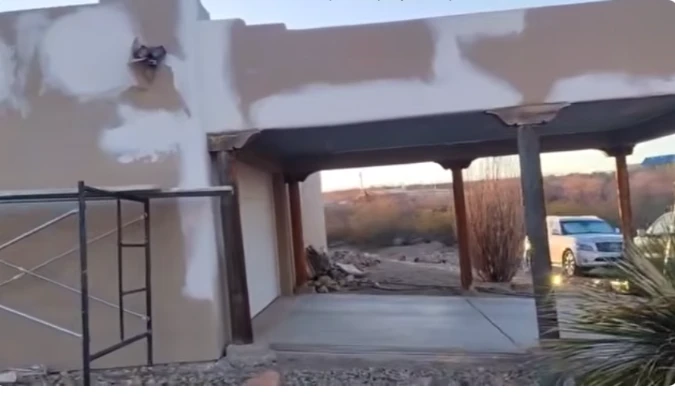
Stucco Crack Repair Las Cruces: What Kind of Crack Is It?
Not every crack is an emergency — but every crack is telling you something. Here is how to read it.
- Hairline cracks, under 1/16 inch — about a credit card’s thickness. Usually cosmetic. Seal them and check again in six months.
- Cracks from 1/16 to 1/8 inch — monitor them. Mark the ends with a pencil and check whether they grow.
- Cracks wider than 1/8 inch — get a pro to look.
- Over 1/4 inch, diagonal, stair-step, or still growing — talk to a structural engineer first, before any patching.
Two quick tests help. The tap test: a sharp ring means the stucco is sound; a dull, hollow drum means it has separated from the wall. The coin test: run a coin along the crack to feel whether the edges are loose. Not sure what you’re looking at? Use our photo guide → — find your damage in photos, with the cause, the severity, and what to do next.
Will a hairline crack get worse if I leave it?
It can. A hairline crack is a way in for monsoon rain, and once water gets behind the stucco, a cosmetic crack becomes a water-damage job. Seal hairline cracks before July and check them again in six months.
Why Stucco Cracks in Las Cruces
- Heat swings. June averages 96°F, with a record of 110°F, and a wall can swing 30–40°F between day and night. That daily expansion and contraction opens hairline cracks — and the fine spiderweb pattern called map cracking, the most common pattern on older Las Cruces elevations.
- Caliche soil moves. Under much of the Mesilla Valley sits caliche, a hardpan at uneven depths, plus clay that swells when wet and shrinks when dry. When the ground settles unevenly, stucco shows it first: stair-step cracks, and cracks at window and door corners.
- Monsoon finds the openings. Las Cruces gets about 9 inches of rain a year, and more than half falls between July and September. Rain hits walls that have baked since April and finds every open crack.
- Sun and age. UV chalks and fades finish coats, worst on west- and south-facing walls. About two-thirds of Las Cruces homes were built before 2000, and most stucco in town is 25–40 years old.
- New-build settlement. One-coat stucco on newer production homes in Sonoma Ranch and East Mesa often shows settlement cracks in the first years.
- Old patches with no mesh. A patch with nothing behind it to grip will pop off with the first thermal swing. Why stucco cracks in Las Cruces →
How We Repair a Crack
Here’s how stucco crack repair Las Cruces work should run, step by step:
- Assessment — The crew walks the whole wall, not just the crack you called about. Tap test, moisture check, parapet and canale check. You get a straight answer about what’s wrong — and what isn’t.
- Open the crack — We widen the crack so the fill bonds. A surface skim over a narrow crack won’t hold.
- Mesh and bonding base coat — The reason repairs fall off is usually no mesh behind them. Every patch goes over mesh and a bonding base coat.
- Patch and texture match — The patch is blended into the surrounding texture — sand float, skip-trowel and smooth finishes matched — and the colour matched to your wall, not to a chart.
- Cure and walkthrough — Proper curing before any coating goes on, then a final walkthrough with you. Our repair process →
Why Do Stucco Repairs Fall Off?
Usually because no mesh was used behind them. A Las Cruces homeowner reported exactly that — a previous repair fell off the wall because there was no mesh behind it. A skim of stucco over a crack with nothing to grip will pop off with the first thermal swing. That’s why every patch we do goes over mesh and a bonding base coat. If a quote doesn’t mention mesh, ask about it.
How Much Does Crack Repair Cost?
Typical estimated ranges — your actual price can be more or less. Your written estimate is free and itemised.
- Hairline crack repair: $150–$500 — (estimated)
- Crack repair: $200–$800 — (estimated)
- Crack repair, national: $400–$1,500 for a 1,500 sq ft home; $8–$20 per sq ft — Angi 2026 (NATIONAL)
What moves the price: the number and length of cracks; the system on your wall (three-coat, one-coat or EIFS); second-storey access and scaffolding; texture matching; and water damage behind the wall. The cheapest Las Cruces stucco crack repair is the one you only pay for once — compare scope first, price second. Full cost breakdown → Try the cost calculator →
When to Call a Pro — and When to Watch and Wait
- Watch and wait: hairline cracks, stable, no water stains. Seal with elastomeric caulk and check again in six months.
- Call a pro: any crack wider than 1/8 inch; cracks that are growing; stair-step or diagonal cracks; stucco that sounds hollow when tapped; any water stains near a crack; patches that fell off.
- Engineer first: cracks over 1/4 inch, still growing, or with doors and windows sticking. That’s a structural question, not a patching question.
DIY Mistakes That Make Cracks Worse
- Painting over a crack. Paint hides it; it doesn’t fix it. The crack reopens.
- Skimming without opening the crack. A surface skim over a narrow crack won’t bond.
- Skipping the bonding agent. This Old House mason Mark McCullough calls the bonding agent “the most important ingredient” — without it, new stucco delaminates, which is likely what caused the original failure.
- Patching EIFS with cement. It won’t bond, and it traps water. EIFS needs compatible foam, mesh and base coat. EIFS repair →
- Wrong mix, no curing. Stucco needs the right mix and proper curing time before coating.
Small hairline cracks are a fair DIY job. Anything wider than 1/8 inch, or any crack with water behind it, is a pro job. DIY stucco mistakes →
Can I fix a stucco crack myself?
A hairline crack, yes — open it slightly, fill it, and seal it. Anything wider than 1/8 inch, or any crack with water behind it, is a pro job. The bonding agent and the mesh are what make a repair hold, and both are easy to get wrong the first time.
Where We Repair Cracks
We repair cracks across Las Cruces and Doña Ana County — Mesilla, Sonoma Ranch, East Mesa, Picacho Hills, Mesilla Park and University Park. See all service areas →
Stucco Crack Questions Homeowners Ask
How do I tell if a stucco crack is serious?
Measure it. Under 1/16 inch is usually cosmetic. From 1/16 to 1/8 inch, mark the ends with a pencil and watch whether it grows. Over 1/8 inch, get a pro to look. Over 1/4 inch, diagonal, stair-step or still growing — talk to a structural engineer first. Tap the wall too: a sharp ring is sound, a hollow drum means the stucco has separated.
What is map cracking, and is it normal?
Map cracking — also called crazing — is a fine spiderweb pattern across the wall, usually from the stucco drying too fast or too much cement in the mix. It is the most common pattern on older Las Cruces elevations. Hairline map cracking is cosmetic: seal it and check it again in six months. If the pattern is spreading fast or the stucco sounds hollow, get it looked at.
Why did my last stucco repair fall off?
Usually because no mesh was used behind it. A Las Cruces homeowner reported exactly that — the previous repair fell off because there was no mesh behind the repairs. A patch needs mesh and a bonding base coat to grip. Ours go over mesh, every time.
Can I just paint over a stucco crack?
No. Paint hides the crack; it doesn’t fix it. The crack reopens with the next thermal swing, and if water is getting in, paint traps it behind the wall. Open the crack, mesh it, patch it, match the texture — then coat it.
How long does a crack repair take?
Most single-wall crack repairs are completed in a day. The patch then needs proper curing time before any coating goes on, and the timing depends on the coats and the weather. Your written estimate includes the timeline before work starts.
Ready for stucco crack repair Las Cruces NM homeowners can check, compare and trust? Send a photo of the crack, or book a visit. You’ll get a written itemised estimate — free, no obligation, no pressure.